Friday, June 1, 2012

A Letter to My Mother

     Yesterday, I returned to my village to pack my hut.  I shoved all my belongings into metal trunks while my host mom sat opposite the room in a plastic lawn chair watching.   Many times her eyes glossed over and tears fell making it impossible for mine not to do the same.

     At one point, I had sent the driver to return a bookcase and table to the school, which left my mother and I alone in my hut.  I sat on my bed and she sat in the chair, both crying as we avoided glances from the other because we knew it would only make us cry harder.

     As I sat, I couldn’t help but reflect and think of how I had gotten to this point.  Here I was crying with a woman and I couldn’t even explain to her how I was feeling because I didn’t know how to say it in a language she’d understand. 
Peter captured this.  It's all in her eyes.
Here’s what I would have said if I could have…

Ma Chao,
     Thank you for all you have done.  Thank you for accepting my ways and thank you for taking me as one of your own.  Thank you for the spoon you gave me on the day I arrived in Demba Kunda.  That day was such a whirlwind that I didn’t realize the meaning of that spoon until much later.

     Thank you for taking me to the garden and letting me sit underneath the mango tree to take it all in; that place was pure peace.  I hope you understood when I breathed in heavily and let out a long happy sigh that I loved it there. 
My mom in the garden
     Please know that my favorite place to be was by your side.  The nights I enjoyed most were the ones I spent sitting next to you under the stars.   Whether we were cracking peanuts, you were painting your feet, or I was listening as you chatted with the other women, when I was by your side, I felt at home.

     Thank you for all the motherly things you did like telling that man not to visit me after dark again.  Thank you for wiping off my face when it was dirty.  Thank you for cooking me tiga sombi, and thank you for yelling my name through my door in the morning to wake me up to fetch my water for the day.  I may have grumbled then, but the thought of it now makes me smile.

     Thank you for your patience and thank you for all the effort you put forth to understand.  I’m not sure when I’ll see you again, but I promise to return. 

With love and gratitude…
Your Daughter,
Isa
I love this woman.

Thursday, May 3, 2012

Thinking in Songs

     When I sit down and try to articulate what has been happening here in The Gambia, songs tend to pop into my head.  Steve Miller singing, “Time keeps on slippin’, slippin’, slippin’ into the future… doo, doo, doo, doo…” comes to the forefront of my mind as I ponder now having lived here for 10 months.

     While each month has been full of activity, April seemed to pass by faster than the rest.  At the beginning of the month, I took off to Kedougou, Senegal with 5 others to celebrate spring break.  We hiked through the bush, bathed in waterfalls, camped in the wilderness, swam in the river, and saw more monkeys than I can count.  When I think of my time spent exploring with other PCVs my mind takes it up a few notches with some Mariah Carey.  “It’s a sweet sweet fantasy baby.” 

     My fantasy life continued when our group was called down to Kombo in the middle of the month for our reconnect.  “Reunited and it feels so good” sang by Peaches and Herb floated through my head as I watched a weeks worth of sunsets, went for late nights to star gaze on the beach, and attended training sessions where free breakfasts and lunches were provided.

     I’d love to say that it continued from there, but when I returned to village Mariah Carey left and Tom Petty and the Heartbreakers singing, “Don’t do me like that,” took the stage.  For months now, I’ve been in a battle with my host family to remove the animal pen they have created next to my hut.  It’s a Peace Corps housing requirement that a volunteer is not placed next to an animal pen for obvious reasons, however I’ve been sharing a fence and window with 5 donkeys, a horse, and 3 cows.  Peace Corps has gone through 4 steps of trying to get my family to relocate the animals, first sending my headmaster to speak with my family, calling themselves, and then on two separate occasions sending out representatives to tell them to fix the problem.  When I left my village for reconnect, Peace Corps gave my family the ultimatum that it’s your volunteer or the animals, one of us was going to have to go.
The animals sharing my fence
     Still on cloud nine from the week I had spent in Kombo, I wasn’t prepared to see that my hairy neighbors hadn’t gotten their eviction notice.  After greeting everyone, I stepped inside my hut to call Alpha, the safety and security officer and the man who is in charge of housing.  He asked to speak with Chima, a village elder in my community, and the same thing that had been happening the past 2 months was happening again.  My family was again saying they would move the animals, but again, nothing was happening.  Soul Coughing’s “I don’t need to walk around in circles, walk around in circles, walk around in circles, walk around in…” started playing on the jukebox, as heat and my emotions took over.  Tears were shed as reality surfaced.  Speaking to my program manager, she informed me that there wasn’t much more they could do, and that she thought it was time that I move to another village.

     I stayed up until 2:30 in the morning packing my bags to wake up at 6 to undistinguishable noises taking place outside.  Curious, I opened my door earlier than I ever have before to find the men shoveling piles of manure onto the back of a donkey cart.  The Backstreet Boys serenaded me with “Quit playing games with my heart,” and confusion hit me like a brick in the face. 

     Although my family was finally starting to show progress towards moving the animals, I stuck with the plans I had made with my program manager on the previous day.  I’m now in Kombo and will be working on a Sarahule workbook for the education trainees coming at the end of June.  In the weeks prior to their arrival, I’ll be helping Joe, the new PCVL (Peace Corps Volunteer Leader) plan their training and then I’ll be leading sessions when they do arrive.  For now, things are up in the air as to where I will go when the workbook and training is finished.  It’s a possibility that I could return to my family, if they do indeed move the animals, or I can also choose to be relocated.

     Until then, I’m going to take comfort in The Five Stairsteps' “Ooh Child,” and know that things will get easier.  On the up side of things, it is the hottest month of the year and I’m one block from the beach.  Things are already getting brighter. J

Tuesday, February 28, 2012

Wrestling in Nyakoi

     It’s been 8 months that I’ve been living in The Gambia, and I’ve been having a hard time coming up with things to write about because everything is becoming normal to me.  That is, until I received a text from Abby inquiring of those who had interest in attending a wrestling match in her village.  Ummm… half naked men wrestling each other to the ground?  I’m THERE! 
     Joe decided to make the 45 minute trek to Abby’s village with me.  Abby lives in Nyakoi, a small village on the north bank, so we had to cross the river on a ferry to get there.  As I pedaled my heart out to keep up with Joe, I had that dog out a window look on my face, excited to be doing something new.
     We got directions to slow down at the first sign of civilization and stop at the half painted mosque. (Road signs are virtually non-existent in this place.)  There, we found Abby waiting for us in the shade of a mango tree.
     She walked us to her compound and I was instantly jealous of the serenity of her home.  She lives with two grandmas and that’s it!  Two compared to the seventy I live with.  You do the math.  It was like pure bliss.
Abby and neighbor girl in front of her hut
     We were told the wrestling would start at 4, but we’ve all been around here long enough to know better.  NOTHING starts when it is suppose to.  We killed time playing Banana Grams (you’re reading from a two-time winner, woot woot) and talking about school, then called Modou closer to 5.  Modou is a village tailor that Abby tutors in English, and was our guide to Gambian wrestling as the night wore on.
     Modou gave us the go-ahead to start walking toward the event grounds.  Stepping outside, drumming and the sounds of whistles filled the air.  The beat did its job.  I was instantly pumped and ready to see some action.
A wrestler and his entourage
     Reaching the main road, we saw mobs of people surrounding wrestlers.  They slowly danced their way to the event hoisting banners above their heads and making as much noise as possible.  My favorite banner, or rather piece of fabric connected with two sticks, was pink and filled with gold and silver hearts.  There’s nothing like coming in with hearts over your head to intimidate your opponent.
Waiting to enter the arena
Multiple matches going on at once
     We purchased tickets feeling good that the proceeds would benefit a recently built clinic in Nyakoi, and entered the arena, a rectangle shaped plot of land enclosed by a grass fence.  It was hard to know where to look.  Bedazzled leggings sparkled in the setting sun.  Neon spandex blinded us.  Men were wrestling while others were dancing around the outside of the ring that had been formed by the viewers.  There didn’t seem to be much order to any of it.  We couldn’t tell who was recording wins and according to Modou, there was no ref.  With so many things going on at once, oh and I mustn’t forget the crowd control that we had to be cautious of (men with sticks and bats), it was a bit of a stimulation overload, but in the best way possible.


     As the sun made its way over the horizon my gittiness started to wear off, and a bit of fear came over me.  Fires were being lit to the right and left of us, and I started surveying the grounds.  Grass fence = dangerous.  No exits = I could die here.
      With fires surrounding us and the crowd making their way in front of us so that we could no longer view the men slamming each other to the ground, we decided we had enough fun for one night and it was time to leave.  We went to where we had been let in but it was now closed off.  The only way to describe it is with Abby Adam’s words… we fought so hard to get out of that place it was like “being birthed.”  Gambians who hadn’t paid were fighting to get in as we were fighting to get out of an opening maybe 2 feet wide.  Modou was doing his best to help us, but there was nothing he could do.  We simply had to push with all of our might against others to make it to the other side.  Getting through the opening you couldn’t help but feel victorious.
     Although I felt like a winner, I have no idea which wrestlers came out on top.  I received text messages from Abby on the following day saying that the improvements they made for the second night of wrestling were monumental.  There were ropes to mark off an arena, people were seated and nicely waiting, and there were two exit slash entrances instead of the one.  Her text ended with, “What a difference a day can make,” but then was followed by, “Guess what?  The thing we all feared happened, and the fence caught fire.  We left as the flames were climbing… Epic.”
     Going into the experience I had no idea what to expect.  I ended up seeing a lot of disorganization and a bit of chaos, but many people having fun and loving life.  Guess it was pretty normal for The Gambia after all. 

Tuesday, February 7, 2012

Dear Donkey


*This is what happens when I get bored in my hut.*

Dear Donkey,

When I look into your eyes
I see past the flies
I can tell your soul is sweet
even in this awful heat
I listen to your horrid screams
and know you’re just blowing of steam

Donkey, I want to tell you how sorry I am
That your owners load you up as if you were a tram
And that the children beat you
And often mistreat you

If you were mine
I’d tell you how good you are all of the time
I’d feed you carrots
and teach you to talk like a parrot

I’d rub your sore back
and never give you a whack
I’d sing you songs
in hope that you would hum along

I’d untie your feet
and let you step to your own beat
I’d clean up your pin
and wouldn’t let it get messy like that again

I’d teach you to say excuse me
because those farts of yours are quite a doozy
and then I’d read you a bed-time story
so you’d know there’d be no need to worry

If you were my donkey…


Sunday, November 27, 2011

I Believe


     Bruised but liberated, I entered Bansang to meet Seth, an environment volunteer that has been serving in The Gambia since January of 2011.  Seth has been placed in the village of Dobong Kunda, approximately 3k outside of Bansang, where he works with the community on developing agriculture.  We walked along a dirt road next to the Gambia River to his village where I was able to meet his host father, Abu Jaiteh.

     Abu mainly speaks Mandinka, and only “small” Sarahule, but despite the communication barrier, we clicked.  I had come to meet Abu because he is a marabout, a religious leader and teacher of the Qur’an, who has been practicing since 1993.  He makes special jujus for people seeking things such as fertility, good health, and protection.  He is so well known for his talent that he was flown to the Ivory Coast in August of 2011 to help Alassane Outtara gain power when Laurent Gbagbo refused to step down.  I was lucky enough to sit down with Abu and see what he does firsthand.
Abu Jaiteh
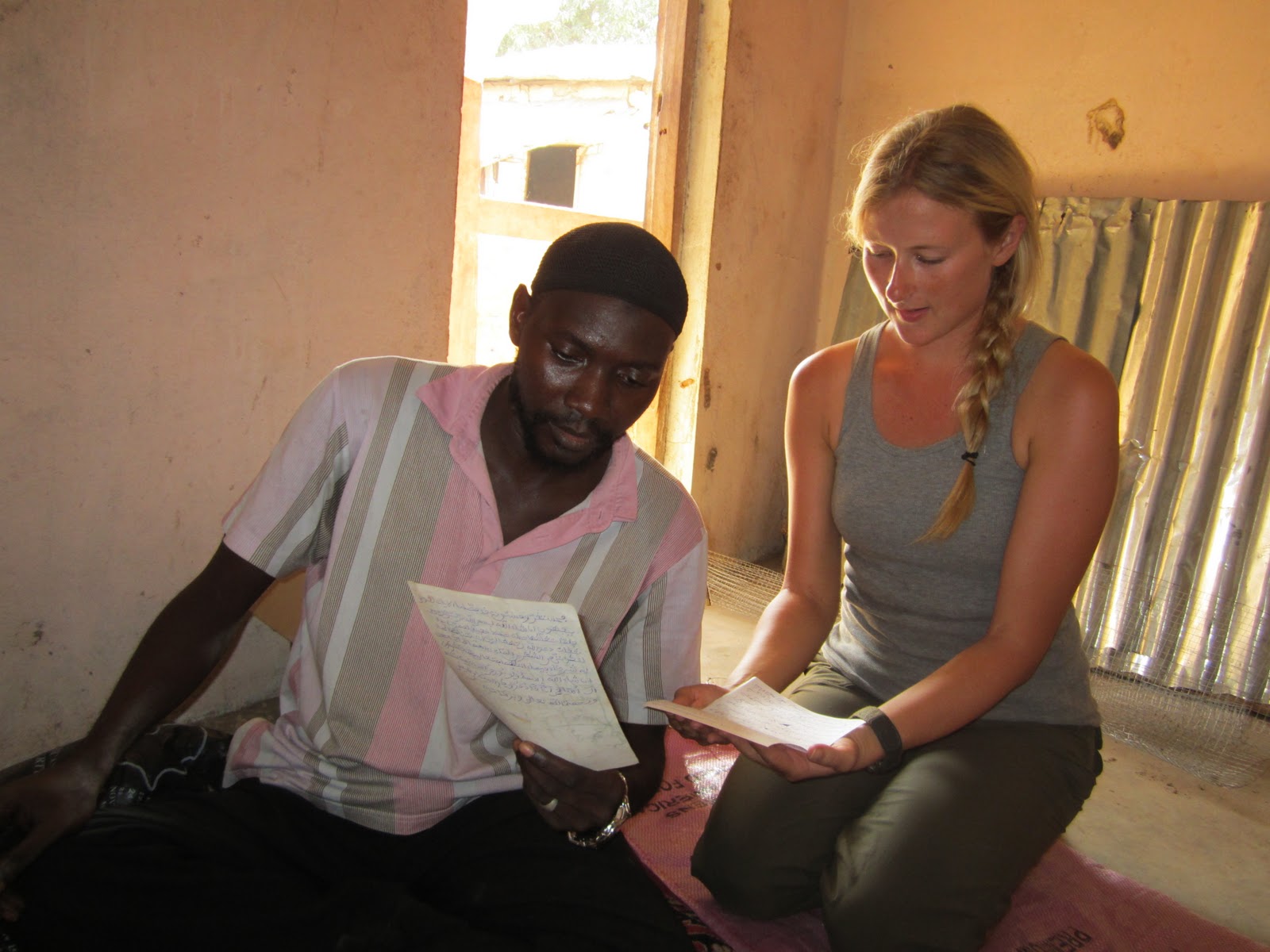
      After eating lunch that Abu’s wife had prepared, Seth, Bully (my translator), and I entered the backroom to Abu’s recently opened bitik (shop).  Abu took a seat on the ground on top of his mat, while we sat on the bed in front of him.  He pulled out his tattered papers that had obviously been used for many years, as he explained that this skill had been passed down to him through many generations.
Bully, my translator
     It was soon my turn to do the talking, as I explained to Abu why I had come to him.  As Abu kept secrets from me in his process of making a juju, I must keep a few secrets from you.  I didn’t go to Abu for myself, but for others.  I have not been able to give my jujus to them yet, so I don’t want to ruin the surprise.  However, I can share what I learned.

     When making the juju, Abu first listens to the person’s problem or what she is seeking.  He then decides upon a passage/prayer from the Qur’an that fits her needs.  He writes this prayer on a piece of paper and then has the recipient, or in my case the one who has come for the juju, to face east on her knees as he reads the prayer.  Although, I had no idea what he was saying because it was all in Arabic, I was asked to repeat “Amen” as he read his prayer.  I did this, as I silently recited my own prayer for those who will be receiving the jujus.  When he was finished he did a spitting motion over the paper I was holding in my hands making a “phh, phh, phh” noise and then took his two hands down his face as an indicator he had completed his work.


     Next, he folded the paper into a tiny square, and for the juju to work correctly, I was asked to exchange my money with him in one hand while receiving the juju in the other.  I then gave the juju back so it could go on to its final stage. 

     Abu “small boyed” a young man to deliver the juju to Lamin Fatty, the leather worker who binds the jujus.  I was told that we could visit him at night to continue watching the making of the juju.  I kicked myself many times for not bringing my camera to our first meeting.

     When we showed up to Mr. Fatty’s compound he was dripping wet and wearing nothing but a towel.  He placed himself in front of me as he finished his work with the leather.  I held my mag light to watch as he adjusted the size to fit on the recipient’s arm.  He spoke in Mandinka about the “niceness” of my light as I marveled at his creation.  I was so pleased with how the juju had turned out that I stayed in Dobong Kunda a second night to have a another one made.
Abu Jaiteh and Lamin Fatty
     Reading this, I’m sure some are questioning my religious beliefs because I participated in an Islamic tradition, so I’ll go ahead and address that…

     Many times in the past five months I’ve had Gambians tell me, “We are all the same.”  My response is always, “I couldn’t agree more.” Whether we are Muslim, Christians, Buddhists, or Hindus I think we are all praying to the same God despite the different names we may use to refer to him.  When asked about my religious affiliation, I simply say, “I believe.”  

Friday, November 25, 2011

I’m a Big Girl Now


     Continuing with my firsts, I recently put on my big girl pants and traveled by myself to the city of Bansang.  Bansang is a two-hour gelli ride from Basse, and is just outside of the village of Dobong Kunda, where Seth and his host father, Abu Jaiteh, live.  Abu Jaiteh is a marabout and was the reason for my travel.

     Excited to meet a marabout, I woke up at the crack of dawn to get ready for my adventure.  I arrived at the car park in Basse around 9, ready to go, but instead began the process of waiting, which is a norm in this culture.  50 minutes later, the gelli to Bansang was filled with Gambians and one toubab (me), and with a running push start, we were off.

     Inside the gelli, personal space became non-existent.  I began the ride with a woman sitting on my right leg, squished next to the metal frame of the seat in front of me.  We shared our two person seat with two others, one of course being the man that screams as loud as he can into his “mobile.” 

     Half way through the ride, our gelli stopped at a police checkpoint.  I’m never quite sure what the police are looking for, but at most checkpoints they will ask to see identification from the passengers.  There were a handful of Gambians that were asked to get off because they didn't have an id or papers to show, and I realized I needed to make myself comfortable on the steel bar that was driving into the back of my legs.  It was going to be a while.

     As the police officer escorted the Gambians lacking ids off to who knows where, a man with a motorcycle approached the gelli wanting to join in on the fun.  Only problem was that he wanted to put his motorcycle on top of the gelli, which proved to be a difficult task.  The men looked as though they knew what they were doing.  They tied rope around the front end of the motorcycle, a few men got on top of the gelli, while others were positioned below and it seemed as though they were trying to wheel it up the side.  I watched three men try to show their strength by lifting the motorcycle, but defeat quickly set in, as they realized it wasn’t going anywhere. 

     About 10 minutes of this nonsense and the Gambians that were still on the gelli started to get furious.  They were shouting things I couldn’t understand, but were obviously fed up and threatening to find another ride as they filed out the back.  The driver, seeing money slip away, quickly made peace with his passengers, and had the motorcycle man put an end to the shenanigans.

     As the passengers boarded back onto the gelli, I heard bits and pieces about the police trying to get money out of them.  I guess it was a “give me money and I won’t waste your time” type of situation.
The one good thing about everyone filing off the gelli is that people gave up their seats.  No longer did I have the screaming man and woman sitting on my lap next to me.  Instead, I now had a 60 to 70 year old man on my side with his arm around me, touching my shoulder with his hand, his cane tucked between his legs, looking rather pimpish. 

     The screaming man became the laughing man as the ride continued.  He had moved to the seat positioned across from mine and was watching my face with every bump we hit.  I went airborne a few times, banged down on the steel rod seat, and winced with pain.  He found this hilarious, but would kindly ask after laughing, “You okay, man?”

     Despite the discomforts, I couldn’t help but to smile the entire way.  Not once was I frustrated by our stop at the police station, the old man touching me, the whiplash I encountered from the poor condition of the road, or the woman sitting on top of me.  I was traveling by myself in The Gambia for the first time, and loving every minute of it.  However, my journey had only begun.   Stayed tuned for my meeting with a marabout…

Thursday, November 10, 2011

There's a First Time for Everything

     October and November have provided a number of first time experiences for me.  I would love to be able to write about each experience individually, but instead I've decided to compile a list of firsts to keep you up-to-date with my adventures.

In somewhat of chronological order:

I dodged dive-bombing bats, and slept on the floor of a classroom for 3 nights in Badari.
I taught about HIV/AIDS prevention to a group of 7th, 8th, and 9th graders, in which I mentioned words like vaginal fluid and semen more than I have in my entire life.
I modeled my first lesson for a teacher.

I was tested with how I'd handle witnessing corporal punishment, and realized I'm not one to just stand by.  I stopped it, immediately.

I traveled across the country in a gelli.

I learned why you don't stand next to animals while waiting to get off the ferry.

I shook hands with the president of The Gambia, and then topped that by dancing with him.
After much debate back and forth with myself, I decided to watch the sacrifice of the ram on Tobaski.  Little did I know that I would get to witness not one, but ten rams meet Jesus.

I tried liver for the first time, which wouldn't be such a big deal had the ram's dead body not been lying in front of me as I ate a piece of its liver.

I was flashed by a crazy man while walking down the main road in Basse, and couldn't think straight for the rest of the day.


That pretty much catches you up on what has been going on in my world.  The past two months have been a bit of a roller coaster with highs of celebrating our 50th anniversary and lows of dealing with corporal punishment.  If you'd like to hear about any event/first in more detail, please feel free to write and I'll gladly tell you everything.  I hope this post finds all of you well and making many firsts of your own.

Saturday, October 8, 2011

A Day Worth Writing About


     “Isa! Samake! Dinka!” Mariama skipped the usual morning greetings as she excitedly told me about a big snake.

     “Mina?”

     “Doke,” she said with a pointing finger.  I gritted my teeth and scrunched my face while shaking my head to show I wasn’t a fan. 

     “Ma laahi samake.”

     “Samake karra,” she said sticking out her tongue and slitting her throat with her finger.  This motion is done any time they tell me something has died, even if it’s a person.  Relieved the big snake was dead, curiosity took over; I wanted to see what is considered a big snake in Africa.  I was not prepared for what I saw…

     The snake was bigger than big.  Its length was well over my height.  I’m guessing it was a good 10 feet or so… definitely the size of a snake that belongs in a zoo.  As I took in the size of the samake dinka in front of me, I couldn’t help but wonder where in the world it was found.  Asking, I found out it was captured and killed near the mosque.  Where’s the mosque?  Right behind my house!  Oh, dear Lord, please help me…

     Snapping a few quick photos, I had to be on my way so I wouldn’t be late for the 8:20 start of school.  The energy that was created in the morning from seeing the snake was carried throughout the day as I observed in classrooms and realized how much work I have to do.  Contemplating how to introduce alternative methods of discipline, I made my way home.  My night was like any other until I went in for bed.


     Needing to reflect on all I had seen that day, I sat down to journal in my dimly lit hut.  Just as I was recording the size of the phython-wanna-be-anaconda snake I had seen that day, I saw something move out of the corner of my eye.  Frightened, I shined my headlamp in the direction of the movement.  I’m not sure what the noise was that came from me, but I was sure that I saw a mouse.  I flew off my chair and ran for the front door. 

     Now, I know that I am much bigger than a mouse, and I shouldn’t be afraid of them, but those suckers are fast and their movement is completely unpredictable.  Thus, I went to find my host father to take care of the job.  He was no where to be found, but luckily I ran into Mohamed, a 24 year old and one of the only 3 English speakers in my compound.  He came in with an attempt to save the day, but the mouse was smart and ran behind my bookcase into a hole and out of reach.  

     Exiting my hut with Mohamed, he said we could try again in the morning, and that he hoped I could sleep through the night.  Offering him no reassurance, I slowly entered my hut, cautious of where I stepped.  I could feel the presence of the mouse, and quickly gained sight of it once more.  It was on my chair!  “Okay, that does it,” I thought to myself.  The mouse was crawling up my stuff, and I’d had enough.  Reciting, “I’m a big girl,” in my mind, I developed a plan.

     I noticed the mouse would take off anytime light was shined in its direction.  Turning off the lights, I hopped on my bed (for some reason I felt safer up there), propped open my back door with my bamboo stool and waited.  Sure enough, the little stinker snuck out the back, and I shut the door behind him with a feeling of triumph. 

     As I tucked my mosquito netting around my bed, I couldn’t help but to laugh at myself.  It had been quite the day.  My giggles soon faded as it dawned on me… snakes eat mice.  Saying an extra prayer, I was able to drift off, ready to take on whatever Africa had in store for me next.

Friday, September 30, 2011

My First Day of School


7:00 a.m.  My un-needed alarm goes off.  The 5 o’clock call for prayer from the blaring speakers attached to the mosque directly behind my compound had already done the trick; that and the screaming donkeys, crowing roosters, and women pounding.  Good morning, Africa.

7:10 a.m.  I fire up my gas stovetop to make my daily cup of oatmeal.  After reaching the perfect consistency, I add a little peanut butter and honey, and think to myself that I can happily eat this for two years.  It’s heavenly.

7:40 a.m.  Time for my first day of school outfit.  It’s nothing too fancy, just a flowered wrap skirt I had made in training village with a matching tika (head wrap).  I put on my new necklace that was sent from my cousin.  It’s leather braided adorned with a globe next to a peace sign.  World Peace.  I love it.  I’m ready.
"World Peace"  Thank you, Lauren!
8:00 a.m.  I make my way outside for my morning greetings turning more heads than usual in my yirame (wrap skirt).  “An wujam.  Hotora ma wuyi?”  Here we go…

8:10 a.m. I notice Bintu, my 16-year-old host sister, pounding and wonder what the deal is.  Just yesterday she had told me she was going to school, and that she was going to be in grade 5.

“Bintu, I thought you were going to school,” I say with a puzzled look on my face.
“I have no uniform.”
“You can’t go to school without a uniform?”
“I don’t go.  I have no uniform,” she repeats.
“Why don’t you have a uniform?”
“Money.  The money is no good.”

Hmm… I know this isn’t the case.  I see Bintu get dolled up on a nightly basis to make her appearance at the football games.  Then they serve free juice with condensed milk to the football players at half time.  They certainly have enough money for a uniform, and Bintu is always the one coming to me with a notebook asking me to teach her, so I know she wants to be there.  I need to get to the bottom of this.

8:15 a.m. Those in uniform gather around me. ONLY FOUR OF YOU!?!?!  What?!?!  There are a bizillion kids in my compound and only four are going to school???  
Nyima, Binta, Mo Mo, and Hawa, my siblings
8:20 a.m. We arrive at school and the kids take off in different directions as I go to greet the 3 out of 12 teachers that have reported for duty.  I’m informed the head master has not arrived.  This has been an on-going issue. 

The headmaster, who I met at the supervisor workshop and who I’ve been in touch with the most has been moved from Demba Kunda to another school by the ministry of education.  He doesn’t want to go, nor does the community want him to leave so he is trying to fight it.  However, in the meantime, this means that no one is in charge at the school.  I’m not sure where the headmaster that was assigned to our school is, but he’s not here, so that means it’s more like a zoo than a school.

8:25 a.m. I unlock the library to retrieve a chair to sit down next to a second year teacher who is finishing his credential so he can become a qualified teacher.  As I’m exiting the library another teacher makes his way over to peak in, and then says, “Isa, come.”  He wants me to know that I should keep the windows locked when I’m not there or else kids will reach in and tamper or possibly steal the books.  Something about the way he states it makes me become a bit defensive.  As I look over to the currently locked windows I tell him, “Yes, I know that’s why I have them locked right now.”  He responds, “Yes, but you being a woman, you might forget.” 


8:35 a.m. Students form lines in their grade levels from shortest to tallest and the morning assembly begins.  Most of the children are glancing at the strange toubab in the back rather than listening to the facts that there is no headmaster, and that there are only 3 teachers.  After they briefly introduce me, the strange toubab, the students are instructed to make their way to their classrooms and help clean up the filth that has collected over the summer.  I watch kids take off in all directions, and can’t imagine that this going to go well.

8:45 a.m.  I peak into the ECD (Early Childhood Development) classroom to find 30 plus 4 year olds unattended.  Holy chaos.  Some are crying, probably because of previously being whacked by another, while others climb on the limited furniture in the room.

9:00 a.m.  Children are littered all over the place.  One teacher sits as another directs the older schoolgirls to start sweeping the courtyard. 

9:15 a.m.  The second year teacher walks over to me and says, “Isa, let’s have breakfast.”  I politely decline his offer.  I already ate breakfast.  In America, we generally do that before we come to school, unless our school is on a special program where the students eat breakfast in school, but that’s not the case here. 

9:20 a.m.  With children still wandering all over the place, I glance down to the world peace necklace my cousin sent and sigh.  There sure is a lot of work to be done in this world.

9:35 a.m.  Boys start joining in on the cleaning by weeding the garden beds.

9:45 a.m.  I’m elated to see Amara and Fatoumata, two more children from my compound, show up.  I ask Amara to show me his classroom by reaching for his little hand and showing him I want him to lead me.  He takes me to the ECD classroom, and I have to fight every urge in my body to get the class together and start teaching them.  I’m here to observe.  I don’t want to step on any toes, and I need to talk to the headmaster about my role in the school before getting down to business.  If only we had a headmaster…
Amara
9:48 a.m.  It sounds like someone is tearing something down in the grade 2 room.  I hear loud banging noises coming from that direction.  I’m afraid to go see what’s happening.  I see the second year teacher walk back onto school grounds.  He must be done with his breakfast.

9:52 a.m.  The teacher that led the morning assembly rings the school bell and orders the students to return to their classrooms.  A mad rush is made by some, while others take their time making their way back to their room where no one awaits them. 

10:00 a.m.  The second year teacher and the other 2 teachers that have reported to school begin their classes.   Grade 5 and 6 are combined into one classroom since the grade 6 teacher isn’t there.  The two rooms of ECD students, grade 1B, and grade 2 and 3 are still unattended. 

10:20 a.m.  Maha, Amara’s father, shows up on his motorbike and decides to take Amara home since school isn’t really going on.  He doesn’t seem surprised or upset by this.  He is certain that tomorrow there will be school.  I inquire about Bintu and it seems as though not having a uniform is not the problem.  From my conversation with Maha, I gather that Bintu’s role in the compound is to work, so although she has the desire to learn, she is stuck pounding, sweeping, and cooking.  

10:30 a.m.  I decide that I’ve seen enough.  I head home contemplating my next steps.  I’ve certainly got some adjusting to do, but can clearly see that I can be used here.  Up next... choosing battles.

Saturday, September 17, 2011

The Desire to Understand


     My curtains are up, my mat is on the floor, and my pictures of the home people (meaning you all in the good ol’ U.S. of A.) are hung.  I’m all settled into my thatch roof hut, and oddly enough, it feels like home.  With only a little over a week under my belt, I’ve already made a few trips to the school, visited the hospital, attended 4 football matches, traveled to Basse multiple times, and done my best to become a part of the Sahoneh family.

     In attempt to understand my overwhelmingly large family better, I started to create a family tree.  I know that I still have family members missing from my tree, because I’ll see someone and have no idea who they are, but from the 60 that are accounted for I have found out many interesting things.  For instance, my host mother, Chao has 8 children, 5 whom live in the compound.  I also was informed that she and her co-wife, Binta, are widows.  When I asked the name of their husband, I was barked at by a 20 some year old boy in the compound who told me not to write down his name.  With my head nearly bitten off, I didn’t ask any more questions about their deceased husband, so I have no idea how he passed, and I imagine it will remain that way for a while because my Sarahule is fairly limited.

     I also learned that many family members, at least 18 that I know of, live outside of the compound, which is relayed with a pointing finger and a word that starts with s.  These members range from husbands to wives to children.  Again, with limited Sarahule I’m not sure if this means they live around the corner, in another village, or another country. 

     For the most part, I take the language barrier with a grain of salt.  I’m able to express my basic needs such as n laahi jii, translated I need water, and I can tell my family where I’m going and when I’ll be back, but there was one day that I found it particularly frustrating that I couldn’t understand.

     After I had made my round of morning greetings to all 60 some members saying, “An wujam (Good morning). Hotora ma wuyi (How did you sleep)? Hotora sun tiya (Hope there is no trouble). Maajam (Peace only),” repetitively, my host-mother and sister, Fatoumata came to my door to say they were going to the hospital.  As they stood there, I realized this meant I was going too.  Locking up, I didn’t know if we were just going to see the hospital, but noticing Fatoumata was carrying a bowl of food on her head, I could only assume we were going to visit someone.

     The hospital was like many depicted on tv… crowded rooms, flies buzzing all over, no doctors to be seen.  As my heart started to sink, it full on plummeted when we made our way to the back room to find a 10 month old baby boy, the reason for our visit.  His eyes were sunken in, the skin was sagging off his tiny legs, and his spine jetted out from his back.  His baby belly poked out displaying his malnutrition, as I read the doctor’s chart, “Severe anorexia, high fever, lesions in mouth.”  It was followed by a list of medical terms, foreign to me, and that’s when the wish to understand washed over me.  I sat quietly for most of our hour visit, taking in as much as I could.  Chao made an attempt to explain to me what had happened to the child.  I heard the words “kombo,” meaning breast, and “suggu” meaning to suck, so I inferred that for one reason or another the little guy was suffering because his mother was unable to breast feed him.  BUT WHY!?!?!

     I asked Hawa, a 16 year old identical twin who was moved from the Bronx by her parents when she was 14 (their story is a blog post in itself that I will have to okay with them first), if she could ask Fatoumata about the boy, but she was unable to relay any new information to me.

     The desire to understand is what drives me each day.  From education, to the dynamics of the family, to football, to the language, to the American girls, to the health care, I want to understand!!!  As I learn more, I will be sure to share my findings.  If there is anything you are interested in learning, please don’t hesitate to ask.  After all, we're in this together.